10-00s
Moritz Wallbrecher
Beyond the Frame: Engineering Human-AI Interaction
Master's Thesis
If AI works best when embedded, the next question is whether it needs to be invoked at all. This thesis proposes a system that infers user intent from OS-level signals (eg. clipboard events, dwell patterns, application switching, document metadata) and surfaces contextually appropriate AI affordances before the user articulates a need.
#*›?¢
□■□■□
Do XY
OKAY?
#*›?¢
□■□■□
Do XY
OKAY?
When delay affects something that matters, drivers reach for their phone — not the car. Current in-car systems show route and ETA, but offer no support for the consequence of being late.
Grounded in five contextual interviews, this project explores how an in-car AI can use situational awareness to support drivers during time-critical journeys, without increasing distraction or breaking mental flow. Built as an interactive HMI simulation with scenario-based triggers.
An editor for the CSS animations already in your project. Ask your coding agent to open one, tune keyframes, timing and easing on a timeline over your real page, hit save, and the agent writes it back.
It plugs into any agent over MCP. The agent only passes file paths; a small sidecar uploads the files and writes the changed declarations back to disk, so a whole session costs a few hundred tokens and every drag in between costs none.
The editor pauses every animation on the page with the Web Animations API, so one playhead drives them all — what you scrub is your actual page, not a mock-up.
SynTwin Product Engineer
Second hire on a three-person product team, shaping the product's core idea and where it goes next, from the user's perspective and UX to building features.
Kingston University London MSc User Experience Design, Distinction (80%)
Focus: Human-AI Interaction, AI-Driven Interfaces, empirical UX research.
BMW Group Creative Technologist Intern, InCar UX
Built the internal pipeline from Figma and Rive onto the in-car runtime; informed BMW iVentures' investment in Rive.
University of Hertfordshire BA Game Design, 2:1 Honours
Thesis: real-time ray-traced UE5 pixel-streamed BMW i5 configurator, 4K/30fps in-browser.
BMW Group Working Student, HV Electronics
Designed and shipped an internal knowledge platform now used daily by ~140 colleagues across 9 departments.
click to pause ↘
[fun project]
Libit
Send any travel guide reel to LibIt. It identifies the places with AI, embeds them by context and adds them to your collection. Find entries through smart searches like “hot weather,” by post or place, or on an interactive map. It also supports recipes and websites.
[fun project]
GoFish!
Fun project back to my game desing roots: A stardew valley, low-bit styled game to play GoFish! with my long distance friends. Early state but you can already play with your friends as well.
[uni project]
Pre-Performance Companion
A grounding tool for the acute moments before presentations, interviews, and important meetings. Four short support modes for different stress responses — not stress prevention, but stress navigation.
[private project]
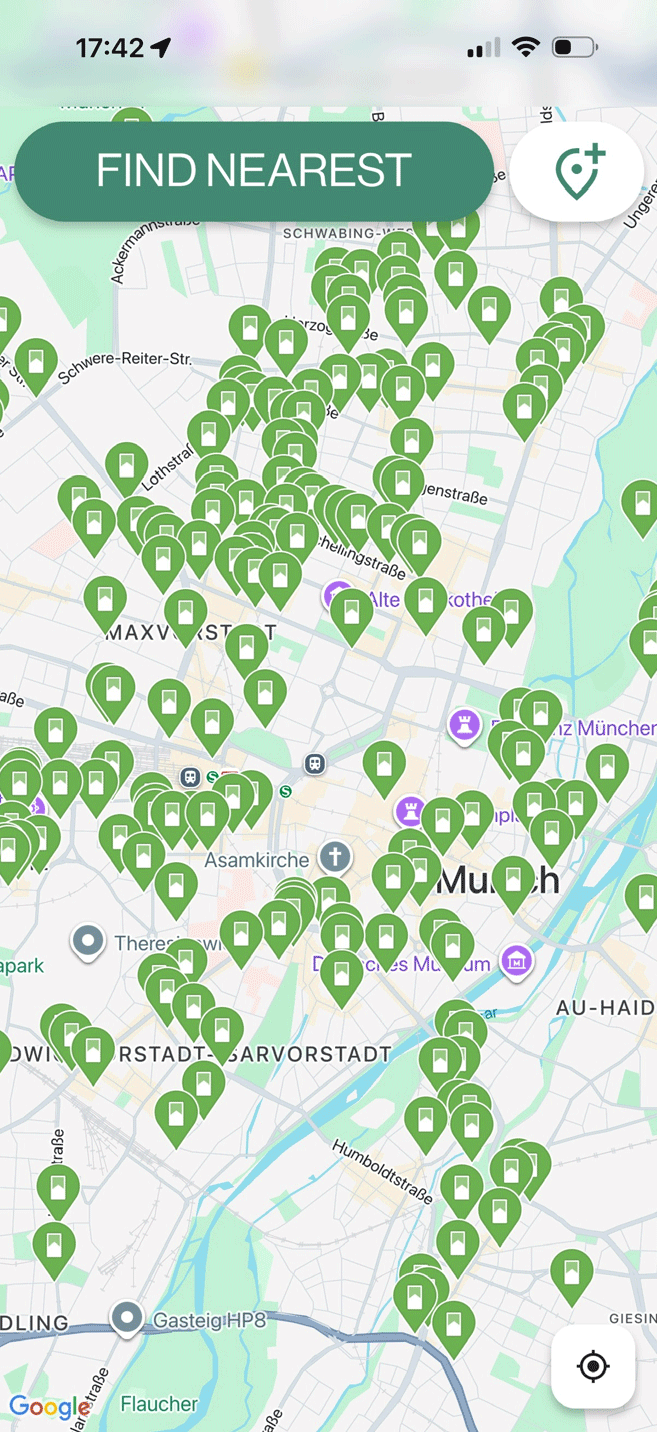
CiggMap
Find the nearest cigarette vending machine in Munich. Users add locations, report broken ones, get directions. 500+ locations, all crowd-mapped by friends and friends-of-friends.